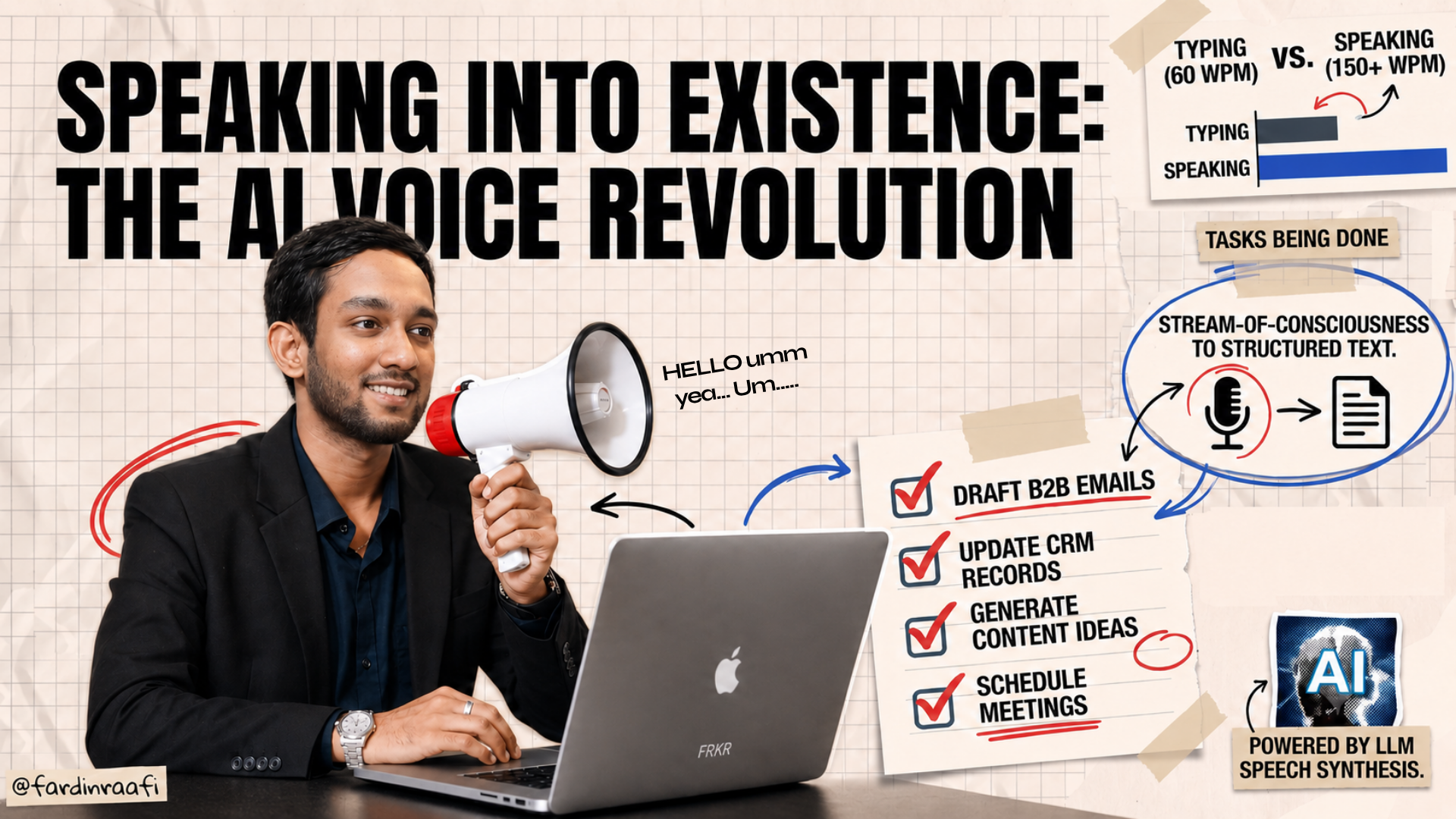
The Keyboard is Dying: How AI Voice Dictation is Reshaping Creation and Productivity
🔹 The Unsilent Revolution in Modern Workspaces
For decades, productivity sounded like the clack of mechanical keyboards. Today, that's changing. Walk into a modern tech workspace, and you're just as likely to hear professionals murmuring into microphones and headsets instead of typing.
The driver is AI-powered voice dictation. Modern LLMs and speech-to-text tools no longer need precise, word-for-word input, they can take raw, rambling speech and turn it into polished, structured documentation in seconds.
🔹 The Shift: Squeezing Out Keyboard Friction
Historically, typing created a physical latency bottleneck between brain signal and text output. An average professional writes between 40 to 60 words per minute, whereas average human speech ranges between 130 to 160 words per minute. Beyond speed, typing forces an immediate cognitive filter: you must pause, formulate grammar, adjust formatting, and physically press keys to transfer ideas.
The Power of Stream-of-Consciousness Prompting
AI dictation technology fundamentally alters this dynamic by capturing raw, unstructured thoughts and allowing artificial intelligence to handle the formatting, synthesis, and restructuring.
- Zero-Friction Brainstorming: Users can simply vocalize immediate ideas without worrying about spelling or syntax.
- Instant Synthesis: LLMs take the raw voice transcript and automatically extract actionable key points, generate structured emails, or draft execution plans.
- Reduction of Physical Fatigue: Removing hours of repetitive keyboard interaction significantly decreases physical strain on wrists and hands.
🔹 Workplace Dynamics and Hardware Adaptation
While voice-first creation increases individual output, it presents new spatial challenges in shared corporate environments. Open-office floor plans, designed around quiet keyboard usage, are struggling to manage ambient chatter as dozens of team members dictate prompts simultaneously.
The Rise of Specialized Hardware
To compensate for noise pollution and privacy concerns, a wave of hardware innovation is emerging:
- Directional Microphones: Gooseneck and noise-canceling headsets tuned specifically to ignore background chatter and isolate close-range speech.
- Hardware Mute Pedals: Programmable foot switches that allow workers to instantly toggle microphone input without interrupting their screen layout.
- Ambient Soundproofing: Sound-dampening phone pods and acoustic dividers designed specifically for voice prompting sessions.
What initially appears as an annoying distraction is actually the natural adjustment period between an old workflow standard and a new technological norm.
🔹 Speed vs. Depth: The Cognitive Debate
As dictation tools proliferate, researchers and business leaders are evaluating the long-term cognitive implications of abandoning typing.
The Argument for Deeper Thinking
Critics argue that typing forces an essential mental step: internal editing. When you type, your brain is forced to organize thoughts before they hit the page. Relying entirely on voice-to-AI processing risks replacing active critical thinking with quick, unrefined input, potentially making team members over-reliant on machine synthesis.
The Argument for Human-Centered Design
Conversely, proponents argue that voice is the most natural human communication medium. Typing was an artificial constraint imposed by early hardware limitations. By allowing professionals to speak naturally, cognitive load is redirected from the physical act of typing to higher-level creative strategy and strategic decision-making.
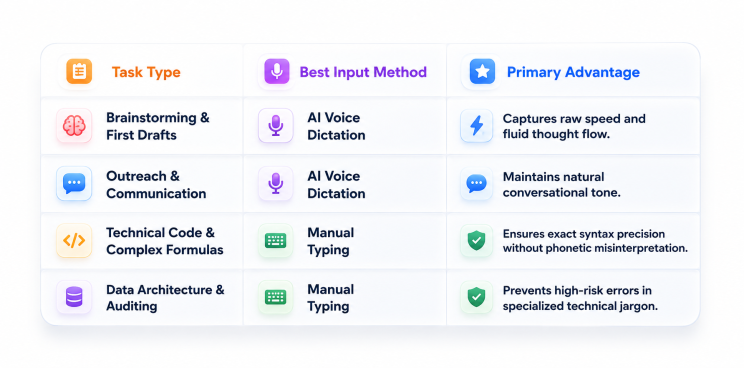
Precision vs. Brainstorming: It is essential to recognize where voice excels and where manual input remains superior.
🔹 Practical Implementation in Daily Workflows
Integrating voice-to-text into daily routines does not require expensive enterprise software overhauls. Most modern operating systems feature robust, built-in speech-to-text engines that can instantly accelerate daily task completion.
🔹 Conclusion: Adapting to the Voice-First Future
Voice-first creation is not a temporary productivity trend; it represents a fundamental transition in how humans interface with technology. As ambient AI models become quieter, smarter, and more contextually aware, the distinction between "thinking," "speaking," and "executing" will continue to blur.
For business managers, marketers, and technical professionals, mastering voice prompting is fast becoming a core operational skill. Those who learn to combine the speed of voice input with the analytical precision of clear editing will set the standard for modern workplace efficiency.
How is your team handling the transition to AI dictation? Are you embracing voice-first workflows or sticking to traditional typing? Let's connect and discuss!
Ready to Upgrade Your Workflows?
If you want to discuss implementing AI tools, improving B2B productivity, or collaborating on a growth strategy, I would love to connect. Reach out for more information!
Contact Me for More Info ➔Read more insights on marketing, tech operations, and productivity frameworks at fardinraafi.com